
What's New in the 12th Foreign Investment Negative List?
Key Reforms That Open Up the Philippine Market to Foreign Ownership
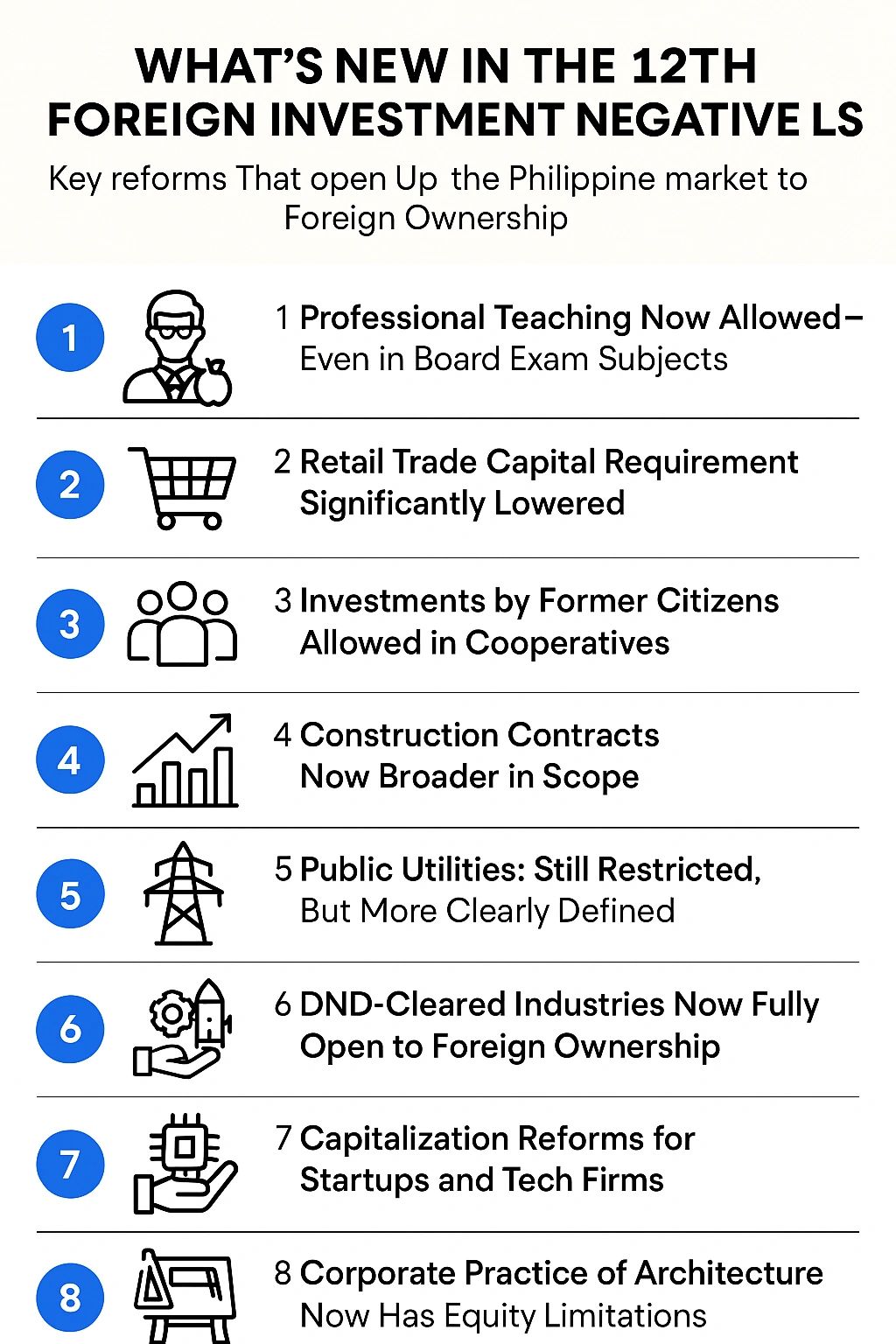
Key Reforms That Open Up the Philippine Market to Foreign Ownership
The 12th Regular Foreign Investment Negative List (FINL)marks a pivotal shift in the Philippines' investment landscape. Designed to promote competitiveness and encourage foreign direct investment (FDI), the updated list lifts or eases previous restrictions across several key industries. Here's a breakdown of the most notable changes and what they mean for potential investors.
1. Professional Teaching Now Allowed—Even in Board Exam Subjects
Before: Foreigners could teach only in higher education and non-professional subjects (i.e., not part of board or bar exams).
Now: The 12th FINL removes this restriction. Foreigners can now teach professional subjects at any level, including those covered by board and bar exams, subject to reciprocity and compliance with regulatory standards.
2. Retail Trade Capital Requirement Significantly Lowered
Before: No foreign equity was allowed in retail trade enterprises with paid-up capital below USD 2.5 million.
Now: The capital requirement has been reduced to PHP 25 million, making it easier for foreign investors to enter the retail sector.
3. Cooperatives Still Restricted, But With an Exception
Before & Now: Foreign ownership in cooperatives remains restricted.
However: Former natural-born Filipino citizens are now allowed to invest in cooperatives.
4. Construction Contracts Now Broader in Scope
Before: Foreign equity was capped at 40% for contracts involving locally-funded public works (with some exceptions).
Now: The restriction has been simplified. Up to 40% foreign equityis allowed across all infrastructure projects under R.A. No. 9184(Procurement Law).
5. Public Utilities: Still Restricted, But More Clearly Defined
Before: Foreign ownership in public utilities was capped at 40%, but the definition of “public utility” was broad.
Now: The Public Service Act has redefined what qualifies as a public utility, including only the following:
- Electricity distribution and transmission
- Petroleum pipeline systems
- Water and wastewater pipeline systems
- Seaports
- Public utility vehicles
Other sectors formerly classified as “public utilities” are now open to greater foreign participation.
6. DND-Cleared Industries Now Fully Open to Foreign Ownership
Before: Up to 40% foreign equity was allowed for businesses involved in the manufacture, repair, storage, and distribution of products requiring Department of National Defense (DND) clearance.
Now: This restriction has been completely removed—foreigners can now own 100% of such businesses, making Subic Bay Freeport Zoneand similar locations strategic entry points for defense-related industries.
7. Capitalization Reforms for Startups and Tech Firms
Before: Foreigners needed a minimum paid-up capital of USD 200,000, unless employing at least 50 workers or using advanced technology.
Now: 100% foreign ownership is allowed with a minimum capital of USD 100,000, if:
- The business involves advanced technology (certified by the DOST);
- The business is an Innovative Startup or Startup Enabler (endorsed by DTI, DICT, or DOST);
- Majority of employees are Filipino, but not fewer than 15.
8. Expanded List of Professions Open to Foreigners
Now allowed, subject to reciprocity:
- Criminology
- Food Technology
- Marine Deck Engineering
- Professional Teaching
- Radiologic & X-ray Technology
- Speech Language Pathology
9. Corporate Practice of Architecture Now Has Equity Limitations
Architecture has been explicitly listed as a profession where corporate practice is allowed but foreign equity is restricted—clarifying a gray area in the previous rules.
Final Thoughts: A New Era for Foreign Investment
The 12th FINL is a significant leap forward for the Philippines as it positions itself as a foreign investor-friendly economy. By relaxing restrictions in education, retail, technology, defense manufacturing, and infrastructure, the country opens its doors wider to global capital and expertise.
For investors looking for strategic locations, Subic Bay Freeport Zone stands out, especially for ventures involved in defense, logistics, and high-value manufacturing. With its former military infrastructure, access to international trade routes, and now fully liberalized ownership opportunities, Subic is poised to become a regional hub for innovation and investment.
Need help starting your business in the Philippines?
Our legal team can guide you through entity registration, DND clearance compliance, and investment structuring. Contact us today.
Published insights are general information, not legal advice for a specific situation.
Visit attytagulao.com ↗